
The HST Rebate Changed the Game. Here's What That Actually Means for Toronto Real Estate.
The headlines focused on the tax savings. The smarter conversation is about supply, timing, and why the next 90 days matter more than most buyers and investors realize.
April 1 arrived — and the market moved immediately
On April 1, 2026, the Ontario and federal governments expanded the HST new home rebate to all buyer types — owner-occupiers and investors alike — on qualifying new construction. The rebate applies to purchases made between April 1, 2026 and March 31, 2027, and can represent savings of up to $130,000 depending on the purchase price.
The response was almost instantaneous. Within the first week, some of Ontario's largest homebuilders reported sales volumes they hadn't seen in years. Minto Group sold nearly 120 new homes across Ottawa and the GTA — a dramatic contrast to the 10–15 units per week they'd been averaging before the announcement. Branthaven, a Southern Ontario builder with more than five decades in the business, sold more homes in that single week than in all of 2025.

"We might have gotten 10 to 15 homes over the course of a week. That's fantastic." — Michael Waters, CEO, Minto Group, on the week-one sales surge
This is not a market recovery. It's policy-driven demand.
There's an important distinction to make before getting too excited about the numbers above. The sales spike in week one does not mean the Toronto market has structurally recovered from the downturn that began in mid-2022. What it means is that government policy created an immediate incentive to act, and buyers who had been waiting — some for months, some for years — responded to that incentive.
Not every builder saw the same result. Fernbrook Homes, which has been building in Ontario for 45 years and developed some of Mississauga's most recognizable skyline condos, reported a flood of calls — and zero sales. Their CEO noted that buyers want full legislative clarity before committing, and as of early April, the rebate has not yet been formally enacted into law. Market confidence, while improving, remains fragile.
So the honest read is this: some demand has arrived. Not all of it. And the demand that has arrived is concentrated in buyers who were already close to a decision and just needed a catalyst. The broader market confidence question — driven by interest rates, the economic environment, and the U.S. trade war — hasn't been resolved by a tax rebate.
The real story isn't demand — it's what's happening to supply.
While the rebate is pulling some future demand into the present, it's doing nothing to reverse three years of supply destruction. The builders responding to this rebate are selling existing inventory. They are not launching new projects. The pipeline feeding the market 18 to 36 months from now is already significantly thinner than it was — and no government incentive can retroactively rebuild it.
The supply cliff
Three years of underbuilding has already decided what 2027 and 2028 look like
To understand what the rebate really means for long-term buyers and investors, you have to step back and look at where the supply pipeline stands heading into the next two years.
Since 2022, more than 10,700 planned condo units in the greater Toronto and Hamilton region have been cancelled outright — including over 1,600 in just the first three months of 2026. Developers have been converting approved condo sites to rental buildings, deferring launches indefinitely, or in some cases being forced into receivership by lenders. Minto, one of the largest builders in the country, stated clearly that they have no plans to launch new condo projects in the near future. They're waiting for excess inventory to clear first.
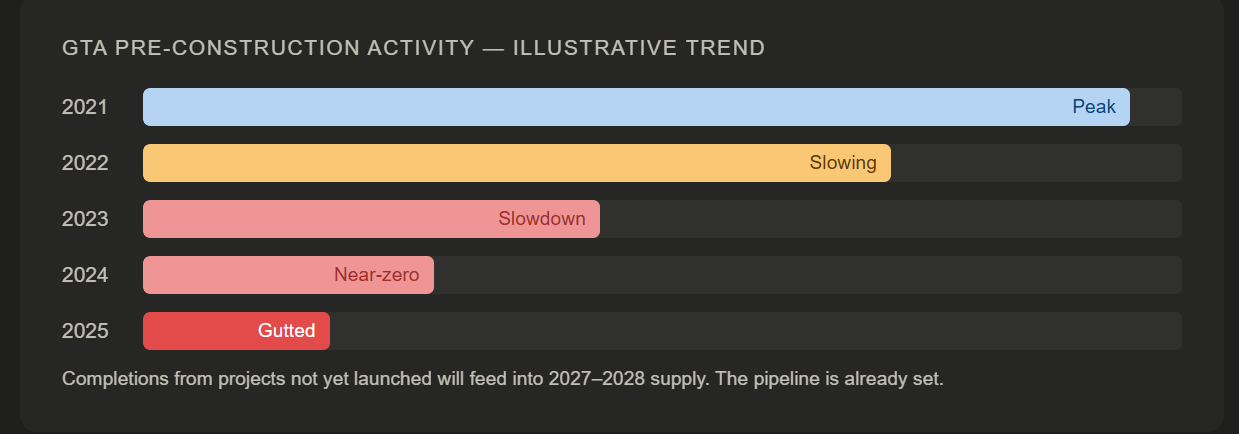
The implications of this are significant and not yet widely priced into the market. Pre-construction projects that aren't launched today won't deliver units in 2027 or 2028. That supply has to come from somewhere — and increasingly, it won't. What that means is a market where demand (stimulated now by the rebate and eventually by rate normalization) collides with structurally constrained supply. When those two forces meet, prices move.
The people who understand this dynamic and position themselves ahead of it are the ones who will look back on this period as a window. The people who wait for the headlines to confirm what the data already shows will be buying at a different price point.
What it means for you
Buyers, sellers, and investors each have a different story right now
Breaking it down by situation
For buyers: Prices are still off their 2022 peak across every property type in the GTA — detached homes are down nearly 7% year-over-year, condos down 9%. The rebate is making new construction more accessible than it has been in years, which temporarily draws some buyers away from resale — reducing your competition. That window won't stay open indefinitely. Buyers who move with a clear strategy in the next 60–90 days are buying before both rates normalize and supply tightens further.
For sellers: The drop in new listings — down 14% to 21% year-over-year depending on property type — means less competition than the price numbers alone suggest. The March 2026 transaction data showed a 30% month-over-month jump in sales volume, confirming that buyers are active. They're selective, not absent. A well-positioned, properly priced listing in this environment moves. A lazily priced one sits. The difference is strategy.
For investors: This is the setup that doesn't come along often — discounted resale prices, a rebate that improves new construction affordability and rental yield math, and a future supply pipeline that's already been hollowed out. The deals being made in the next 90 days are being made before the broader market reprices for the shortage that's already locked in. I've been investing in Toronto real estate since 2006. In my experience, the moments that look the best in hindsight rarely felt comfortable in real time. This is one of those moments.
Important caveat
Not everything is resolved — here's what's still uncertain
Fair-minded analysis requires acknowledging what's still unresolved. The rebate has not yet been formally enacted into law. As of early April, the Ontario Finance Ministry and the federal Finance Department are still working through implementation details — and some buyers are wisely waiting for that clarity before committing.
Market confidence, while improved, is still fragile. Broader economic uncertainty — including the ongoing trade situation with the U.S. — continues to dampen sentiment for a segment of buyers. And not every builder has seen the sales surge that Minto and Branthaven reported. Supply absorption will happen unevenly across product types and geographies.
None of this changes the structural supply argument — those cancelled units don't un-cancel themselves regardless of legislation timelines. But it does mean that anyone moving right now should be doing so with a clear strategy, proper due diligence, and an understanding of what they're buying and why — not simply because of the excitement around the rebate announcement.
Ready to understand what this means for your specific numbers?
Every situation is different. Whether you're a first-time buyer, a move-up seller, or an investor trying to position for the next cycle — I'm happy to map it out without the generic advice.
Book a Call →
📞 416-220-0269
📧 Niesh@remaxwealth.com